
Comparing International Online Casino Payment Methods: Why US Players Look to Canadian Interac E-Transfer Models in 2026
Comparing International Online Casino Payment Methods: Why US Players Look to Canadian Interac E-Transfer Models in 2026
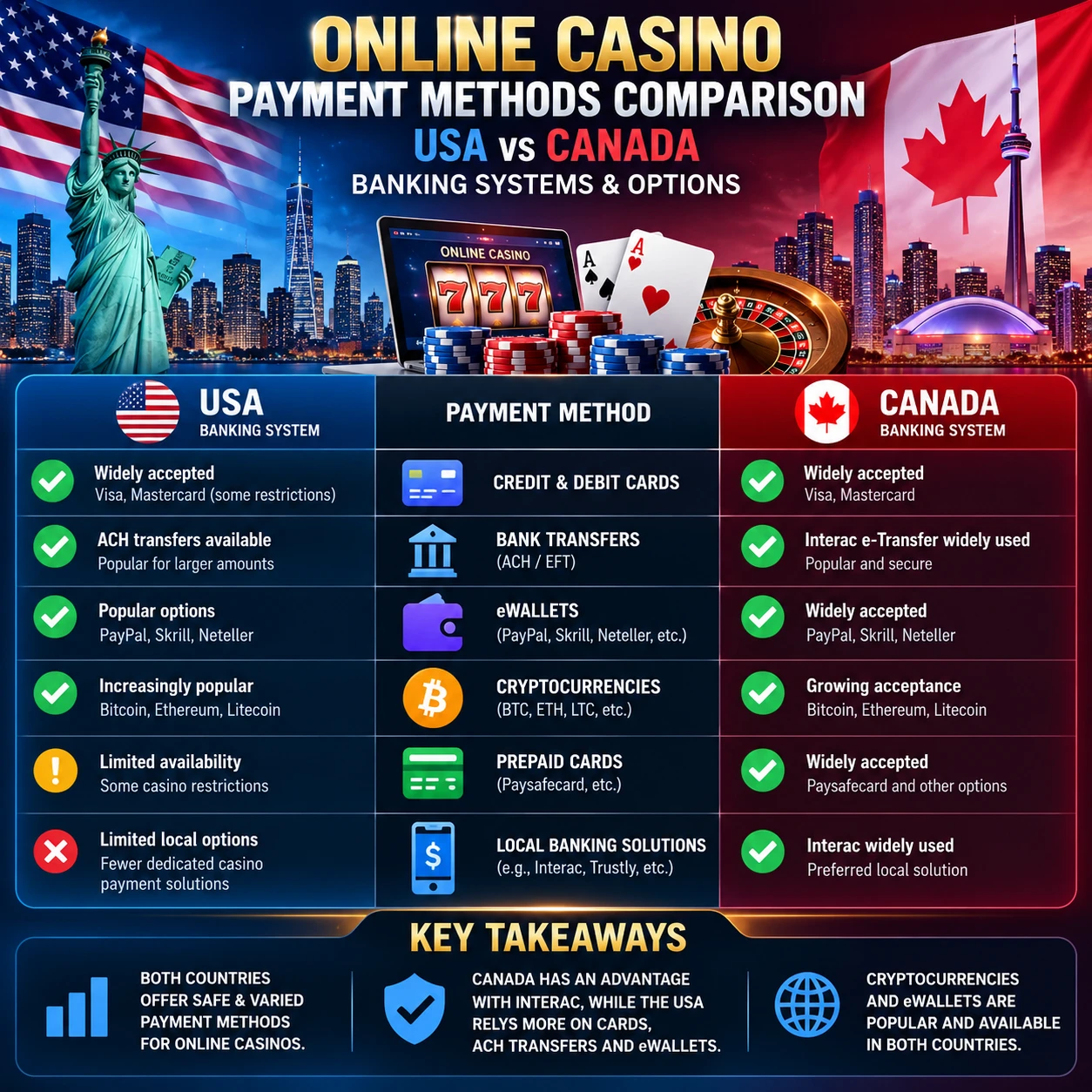
I've been tracking the online casino scene for a while now, and honestly? The frustration among US players in 2026 has hit a new level. Sure, we've got legal online casinos spreading across more states, but the banking side is still stuck in the past. Fragmented. Clunky. Every conversation I have with players—doesn't matter if they're in Jersey or Michigan—ends up circling back to the same complaints: withdrawals that drag on forever, payment options that feel limited, and this maze of third-party processors turning what should be simple into something needlessly complicated.
Here's what caught my attention though. US players keep looking north to Canada, almost enviously. The Canadian online casino payment setup, especially the interac e transfer casino model, is basically everything we wish we had down here: deposits that hit instantly, same-day withdrawals, direct bank connections, acceptance everywhere. Now, US players can't just hop on and use these Canadian systems, but figuring out why they work so smoothly? That's become our benchmark for what we should be pushing our regulators and operators to deliver.
The gap between these two markets is pretty stark. Canadian players move money bank-to-bank through one unified national system. Meanwhile, we're stuck navigating this patchwork of state-specific rules, each with its own approved methods and processing quirks. It's not just annoying—it actually degrades the whole gaming experience and raises some real questions about why American innovation seems to have stalled out in this one sector.
The Current State of US Online Casino Payments in 2026
Let me just say it: the US online casino payment scene in 2026 is still a disaster. We've got legal operations running in New Jersey, Pennsylvania, Michigan, West Virginia, Connecticut, Delaware—but each state's basically its own island. Something that works perfectly in New Jersey? Might not even be an option in Michigan. Pennsylvania often runs a completely different setup.
The payment methods I see US players dealing with most include PayPal (when it's even available), Play+ prepaid cards, online banking through Trustly or VIP Preferred, regular debit cards, and eChecks. Every single one has frustrating limits. PayPal's convenient, sure, but it's not accepted everywhere or in every state. Play+ cards mean you're loading funds onto yet another prepaid account—extra steps. Debit cards? They get declined all the time because banks still have policies against gambling transactions. And eChecks can take 4-7 business days just to clear a deposit. That's ridiculous.
Withdrawals are even worse. Deposits might go through fairly quickly, but actually getting your winnings out? You're looking at anywhere from 24 hours to 5 business days depending on what method you picked. PayPal withdrawals are usually fastest at 24-48 hours, but online banking transfers and checks stretch to 3-5 days. Some players still get paper checks mailed to them. In 2026. It feels absurd.
The real problem here is that online casinos and the US banking system just aren't integrated. Most banks still maintain those anti-gambling policies, so casino operators route payments through third-party processors and middlemen. Every extra link in that chain adds processing time, fees, potential failure points. It's a system built on workarounds instead of actual connections, and players feel it every time they move money.
How Canadian Casino Payment Systems Work
When I dug into how the Canadian system actually functions, I'll admit—I felt a little jealous. The payment method that dominates across virtually all Canadian online casinos is Interac e-Transfer, and it's fundamentally different from anything widely available here in the States.
Interac e-Transfer is built right into the online banking platforms of basically every Canadian bank. When a Canadian player wants to deposit, they just start an e-Transfer from their bank account using their regular online banking login. The casino gets the funds almost instantly. Player starts gaming within minutes. No setting up intermediary accounts, no registering with third-party processors, no worrying whether their bank's going to block it.
Withdrawals work just as smoothly. Player requests a withdrawal, casino sends the money back via Interac e-Transfer straight to their bank account. Most withdrawals process within a few hours to 24 hours—a timeline that seems almost unbelievable if you're a US player used to waiting days. The whole thing runs on banking infrastructure Canadians already use for everyday stuff, which is why adoption's been so seamless.
The security setup is solid too. Because e-Transfers go through the player's existing bank login and authentication, there's already two-factor authentication and fraud protection built in. Players aren't handing their banking details directly to casinos—the transfer happens through the secure banking network Canadians already trust for paying rent, splitting bills, handling business transactions.
Why Interac e-Transfer Dominates in Canada
Interac's dominance in the Canadian online casino market didn't just happen by accident. A few key factors combined to make it the go-to for most Canadian players, and understanding these shows exactly what's missing in the US market.
First off, there's universal acceptance. Interac isn't some niche processor—it's the backbone of electronic payments across Canada. Every major bank supports it. Canadians have been using it for years to send money to friends, pay bills, handle person-to-person transfers. When online casinos started accepting it, players didn't need to learn anything new or trust some unfamiliar company. They were just using the same tool they'd use to pay their landlord.
Second, that direct bank connection cuts out the middleman problem we deal with in US transactions. No payment processor taking a cut, no prepaid card company adding complexity, no third-party service that might randomly decide to stop serving gambling customers. The money goes straight from your bank to the casino's bank through the Interac network. Keeps fees low, processing fast.
Third, the speed changes everything. Deposits hit instantly or near-instantly. Withdrawals typically land in your account same day or within 24 hours. That creates a level of trust and convenience that completely transforms the player experience. You're never left wondering if your withdrawal's actually going to show up or sitting around for days waiting to access your own money.
And the fee structure's player-friendly. Lots of Canadian online casinos don't charge anything for Interac deposits or withdrawals. When fees exist, they're minimal—maybe $1-2 per transaction. Compare that to some US methods charging percentages or hefty flat fees, and the value's obvious.
Key Differences Between US and Canadian Casino Banking
Having looked at both systems up close, I can lay out the contrasts that make Canadian casino banking objectively better than what we're stuck with. The differences go beyond just payment methods—they're fundamental structural issues in how each country handles online gambling regulation and banking integration.
The regulatory framework is the foundation. Canada's got federal criminal code provisions allowing provincial gambling regulation, but the banking system operates nationally without breaking into fragments. In the US, state-by-state regulation means payment processors, banks, and casinos navigate completely different rules in New Jersey versus Pennsylvania versus Michigan. That fragmentation makes it nearly impossible to build the kind of unified payment infrastructure Interac represents.
Payment method availability reflects this mess. Canadian players have Interac e-Transfer available universally, plus credit cards, crypto, other alternatives. US players deal with a confusing mix that changes by state and casino: PayPal here but not there, Play+ at some operators, Trustly at others, constant uncertainty about which methods will actually work with their specific bank.
Processing speeds tell the real story. Canadian deposits via Interac are instant. Withdrawals process within hours to one day. US deposits might be quick if you're using PayPal or a prepaid card that's already loaded, but withdrawals routinely take 2-5 business days. I've talked to players who waited a full week to get their winnings through some US methods—a timeline Canadians would consider completely unacceptable.
Fee structures diverge significantly too. Canadian Interac transactions usually carry zero fees or minimal fees under $2. US players face payment processor fees, withdrawal fees, expedited processing fees, sometimes even deposit fees depending on their method. Those costs add up fast, especially for players who deposit and withdraw regularly.
Speed and Convenience Comparison
Let me break down the speed comparison with actual numbers, because the difference is dramatic. From what I've seen and researched, Canadian players using Interac e-Transfer can expect deposits to appear in their casino account within 1-5 minutes. The withdrawal process typically takes 2-24 hours from when the casino approves it to when funds hit the player's bank account. Some Canadian casinos even advertise same-day withdrawals as standard, not some premium feature.
US players face a completely different reality. PayPal deposits might be instant, but PayPal withdrawals take 24-48 hours. Online banking methods like VIP Preferred or Trustly can take 24-72 hours for withdrawals. Traditional bank transfers or checks stretch to 5-7 business days. I've heard from players who requested a withdrawal Monday and didn't see the money until the following Monday. A full week.
The convenience factor goes beyond speed. Canadian players use one method for everything—their regular bank account. US players juggle multiple payment accounts: PayPal account, Play+ prepaid card, maybe Skrill or a crypto wallet for certain casinos. Managing all those accounts, remembering which works where, dealing with different verification requirements for each platform—it creates friction Canadian players don't experience at all.
What US Players Can Learn from the Canadian Model
The Canadian Interac model offers concrete lessons US players, operators, and regulators should actually pay attention to. First and most important: direct banking integration is possible without compromising security or regulatory compliance. Canadian banks haven't collapsed. Fraud hasn't spiraled out of control. Problem gambling hasn't increased just because e-Transfers are convenient. The system works because it's built on existing, trusted infrastructure.
Second lesson: universal standards beat fragmentation every time. Interac works across all Canadian provinces, all banks, all online casinos because it's standardized. The US could benefit enormously from interstate cooperation to establish common payment standards working across state lines. Individual states don't need to give up regulatory authority over gambling—they could just coordinate on payment infrastructure.
Third, cutting out middlemen improves both speed and cost. Every payment processor, prepaid card company, third-party service in the transaction chain adds time, fees, potential failure points. A direct bank-to-casino transfer model eliminates those issues. The challenge for the US is overcoming banks' historical reluctance to process gambling transactions directly.
What would an 'American Interac' actually look like? Probably needs to be built on the FedNow instant payment system that launched recently, or the existing ACH network with faster processing. Would require federal-level clarity on banks processing online gambling transactions—or at least coordinated state-level agreements. And it would need buy-in from both the banking industry and casino operators to establish universal standards.
We don't have this solution yet in 2026. But understanding what's possible helps US players push for better options and helps regulators see what modern casino banking should actually look like. The Canadian model proves convenient, fast, secure casino payments are entirely achievable when regulatory and banking infrastructure align properly.
Alternatives for US Players Seeking Faster Transactions in 2026
While we wait for systemic improvements, there are strategies and methods offering relatively faster, more convenient transactions. Based on my research and player feedback, here are the best options currently available for US players wanting to minimize payment friction.
Cryptocurrency's emerged as the fastest option for many US players. Bitcoin, Ethereum, Litecoin, other cryptos offer near-instant deposits and withdrawals typically processing within 1-24 hours regardless of state regulations. The downside? Learning curve for players unfamiliar with crypto, price volatility, and not all casinos accept cryptocurrency. But for players willing to navigate the crypto ecosystem, it's the closest thing to Interac's speed currently available in the US market.
PayPal remains the gold standard among traditional methods where it's available. Deposits are instant, withdrawals typically process within 24-48 hours, most people already have PayPal accounts. The limitation is availability—PayPal isn't offered at all US online casinos, not available in all states. Where you can use it though, it's generally the best traditional option.
Play+ prepaid cards offer middle-ground. These casino-branded prepaid cards let you load funds from your bank account or debit card, then use the Play+ balance for instant deposits and relatively fast withdrawals (usually 1-3 days). The extra step of managing a prepaid account is less convenient than direct banking, but Play+ is widely accepted across multiple casino operators and states—provides some consistency.
Instant banking services like Trustly and VIP Preferred connect directly to your bank account for deposits and withdrawals without requiring a separate account. Deposits are typically instant, withdrawals can process in 24-72 hours. These services are growing in availability and represent a step toward the direct banking model working so well in Canada, even if they're not quite as fast or universal yet.
For players prioritizing speed above everything else, my recommendation in 2026: use cryptocurrency if you're comfortable with it, PayPal where available, or instant banking services as third option. Avoid mailed checks or standard bank wires unless absolutely necessary—those add days to your transaction times.
The Future of US Casino Payment Methods
Looking ahead, I'm cautiously optimistic about improvements to US casino payment systems, though I don't expect dramatic overnight changes. Several developments could potentially bridge the gap between where we are now and the seamless Canadian model inspiring so much envy among US players.
The FedNow instant payment system launched by the Federal Reserve represents the most promising infrastructure development. FedNow enables instant bank-to-bank transfers in the US, similar to what Interac provides in Canada. If online casinos and state regulators can establish frameworks for using FedNow for gaming transactions, we could finally have the direct banking integration that's been missing. Challenge is getting banks comfortable processing gambling transactions and ensuring regulatory compliance across state lines.
State-level innovations are already starting to emerge. Some states are working with payment processors to develop faster ACH processing specifically for online gambling. Others are exploring state-specific instant banking solutions. While this maintains the fragmentation problem, it at least moves individual states toward faster transaction times. If several large states like New Jersey, Pennsylvania, Michigan develop solid models, those could potentially adapt to other states.
The banking industry's evolving attitude toward gambling transactions is another factor worth watching. As more states legalize online casinos and gambling becomes increasingly mainstream, banks are slowly reconsidering blanket anti-gambling policies. Major banks allowing debit card deposits at online casinos represents progress, even if we're not yet at seamless integration.
Realistically, I expect incremental improvements over the next 2-3 years rather than sudden transformation. Withdrawal times might compress from 3-5 days to 1-2 days as faster ACH processing becomes standard. More states might approve PayPal and other instant methods. Crypto adoption will likely keep growing among players seeking speed. But a truly unified, Canada-style system probably requires federal-level action on payment infrastructure for gambling—which remains politically complicated.
What US players can do is keep advocating for better payment options, choose casinos and states offering faster methods, and make it clear to regulators that payment convenience matters for player satisfaction and safety. The more demand there is for Canadian-style speed and convenience, the more pressure there is on the industry to deliver actual solutions.
Conclusion
The payment gap between US and Canadian online casino systems represents one of the most significant quality-of-life differences for players in 2026. American players navigate fragmented regulations, multiple third-party processors, multi-day withdrawal times. Canadian players enjoy instant deposits and same-day withdrawals through a unified, bank-integrated system. This isn't just about convenience—it's about trust, security, the fundamental user experience of online gambling.
US players can't simply access Interac e-Transfer or replicate the Canadian model individually, but understanding why it works so well serves real purposes. Provides a benchmark for what modern casino banking should look like. Helps players evaluate and choose the best available options in the current US market. Gives concrete examples regulators and operators should study when designing future payment systems.
Until we see systemic improvements, US players can optimize their experience by choosing faster payment methods like crypto or PayPal where available, avoiding slow methods like checks, supporting casinos and states that prioritize payment innovation. The Canadian model proves the technology and infrastructure for fast, secure, convenient casino payments already exist. Now it's a matter of regulatory frameworks, banking partnerships, industry will to bring similar solutions to the United States. The gap's real, but it's not permanent. And knowing what's possible is the first step toward demanding better.